Empirical risk minimization (ERM) is a principle in statistical learning theory which defines a family of learning algorithms and is used to give theoretical bounds on their performance. The core idea is that we cannot know exactly how well an algorithm will work in practice (the true "risk") because we don't know the true distribution of data that the algorithm will work on, but we can instead measure its performance on a known set of training data (the "empirical" risk).
Background
Consider the following situation, which is a general setting of many supervised learning problems. We have two spaces of objects 





To put it more formally, we assume that there is a joint probability distribution 


We also assume that we are given a non-negative real-valued loss function 


![R(h)={\mathbf {E}}[L(h(x),y)]=\int L(h(x),y)\,dP(x,y).](https://wikimedia.org/api/rest_v1/media/math/render/svg/7ad0926c0c7dbf4fa719987b028ff25c5fd678cb)
A loss function commonly used in theory is the 0-1 loss function: 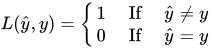
The ultimate goal of a learning algorithm is to find a hypothesis 


Empirical risk minimization
In general, the risk
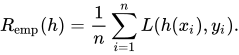
The empirical risk minimization principle[1] states that the learning algorithm should choose a hypothesis 
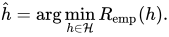
Thus the learning algorithm defined by the ERM principle consists in solving the above optimization problem.
Properties
Computational complexity
Empirical risk minimization for a classification problem with a 0-1 loss function is known to be an NP-hard problem even for such a relatively simple class of functions as linear classifiers.[2] Though, it can be solved efficiently when the minimal empirical risk is zero, i.e. data is linearly separable.
In practice, machine learning algorithms cope with that either by employing a convex approximation to the 0-1 loss function (like hinge loss for SVM), which is easier to optimize, or by imposing assumptions on the distribution
| This article uses material from the Wikipedia article Metasyntactic variable, which is released under the Creative Commons Attribution-ShareAlike 3.0 Unported License. |