In the fields of machine learning, the theory of computation, and random matrix theory, a probability distribution over vectors is said to be in isotropic position if its covariance matrix is equal to the identity matrix.
Formal definitions
Let 


A set of vectors is said to be in isotropic position if the uniform distribution over that set is in isotropic position. In particular, every orthonormal set of vectors is isotropic.
As a related definition, a convex body 


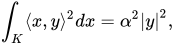
for all vectors 

| This article uses material from the Wikipedia article Metasyntactic variable, which is released under the Creative Commons Attribution-ShareAlike 3.0 Unported License. |