In computational learning theory (machine learning and theory of computation), Rademacher complexity, named after Hans Rademacher, measures richness of a class of real-valued functions with respect to a probability distribution.
DefinitionsEditRademacher complexity of a setEdit
Given a set  , the Rademacher complexity of A is defined as follows:[1][2]:326
![{\displaystyle \operatorname {Rad} (A):={\frac {1}{m}}\operatorname {E} \left[\sup _{a\in A}\sum _{i=1}^{m}\sigma _{i}a_{i}\right]}](https://wikimedia.org/api/rest_v1/media/math/render/svg/c47ceb99cecf0b8319984076b7b7dd2dd99c5b76)
where  are independent random variables drawn from the Rademacher distribution i.e.
  for
for  , and
, and  . Some authors take the absolute value of the sum before taking the supremum, but if
  is symmetric this makes no difference.
Rademacher complexity of a function classEdit
Given a sample  , and a class
  of real-valued functions defined on a domain space
  , where
  is the loss function
  of a classifier
  , the empirical Rademacher complexity of given
  is defined as:
![{\displaystyle \operatorname {Rad} _{S}(F)={\frac {1}{m}}\operatorname {E} \left[\sup _{f\in F}\sum _{i=1}^{m}\sigma _{i}f(z_{i})\right]}](https://wikimedia.org/api/rest_v1/media/math/render/svg/0a67592d2eb2adb8dfd8f7caabcb2907fd342d14)
This can also be written using the previous definition:[2]:326

where  denotes function composition, i.e.:

Let  be a probability distribution over . The Rademacher complexity of the function class with respect to for sample size
  is:
is:
![{\displaystyle \operatorname {Rad} _{P,m}(F):=\operatorname {E} _{S\sim P^{m}}\left[\operatorname {Rad} _{S}(F)\right]}](https://wikimedia.org/api/rest_v1/media/math/render/svg/8b24bbac0a633a216b7362313201ec6044d3d09c)
where the above expectation is taken over an identically independently distributed (i.i.d.) sample  generated according to .
ExamplesEdit1. contains a single vector, e.g.,  . Then:

The same is true for every singleton hypothesis class.[3]:56
2. contains two vectors, e.g.,  . Then:
![{\displaystyle {\begin{aligned}\operatorname {Rad} (A)&={1 \over 2}\cdot \left({1 \over 4}\cdot \max(1+1,1+2)+{1 \over 4}\cdot \max(1-1,1-2)+{1 \over 4}\cdot \max(-1+1,-1+2)+{1 \over 4}\cdot \max(-1-1,-1-2)\right)\\[5pt]&={1 \over 8}(3+0+1-2)={1 \over 4}\end{aligned}}}](https://wikimedia.org/api/rest_v1/media/math/render/svg/648d58d1aa685edcb645203422b9514b043a100d)
Using the Rademacher complexityEditThe Rademacher complexity can be used to derive data-dependent upper-bounds on the learnability of function classes. Intuitively, a function-class with smaller Rademacher complexity is easier to learn.
Bounding the representativenessEdit
In machine learning, it is desired to have a training set that represents the true distribution of some sample data . This can be quantified using the notion of representativeness. Denote by the probability distribution from which the samples are drawn. Denote by  the set of hypotheses (potential classifiers) and denote by the corresponding set of error functions, i.e., for every hypothesis
  , there is a function
  , that maps each training sample (features,label) to the error of the classifier (note in this case hypothesis and classifier are used interchangeably). For example, in the case that represents a binary classifier, the error function is a 0–1 loss function, i.e. the error function
  returns 1 if correctly classifies a sample and 0 else. We omit the index and write instead of when the underlying hypothesis is irrelevant. Define:
![{\displaystyle L_{P}(f):=\operatorname {E} _{z\sim P}[f(z)]}](https://wikimedia.org/api/rest_v1/media/math/render/svg/21742badbe585cd94fe474dbc58674cca4185e04) – the expected error of some error function
– the expected error of some error function  on the real distribution ;
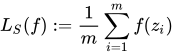 – the estimated error of some error function on the sample .
The representativeness of the sample , with respect to and , is defined as:

Smaller representativeness is better, since it provides a way to avoid overfitting: it means that the true error of a classifier is not much higher than its estimated error, and so selecting a classifier that has low estimated error will ensure that the true error is also low. Note however that the concept of representativeness is relative and hence can not be compared across distinct samples.
The expected representativeness of a sample can be bounded above by the Rademacher complexity of the function class:[2]:326
![{\displaystyle \operatorname {E} _{S\sim P^{m}}[\operatorname {Rep} _{P}(F,S)]\leq 2\cdot \operatorname {E} _{S\sim P^{m}}[\operatorname {Rad} (F\circ S)]}](https://wikimedia.org/api/rest_v1/media/math/render/svg/09909da91e76d4385aff2e1e2c6a50c6433ad544)
Bounding the generalization errorEdit
When the Rademacher complexity is small, it is possible to learn the hypothesis class H using empirical risk minimization.
For example, (with binary error function),[2]:328 for every  , with probability at least
  , for every hypothesis :

Bounding the Rademacher complexityEditSince smaller Rademacher complexity is better, it is useful to have upper bounds on the Rademacher complexity of various function sets. The following rules can be used to upper-bound the Rademacher complexity of a set  .[2]:329–330
1. If all vectors in are translated by a constant vector  , then Rad(A) does not change.
2. If all vectors in are multiplied by a scalar  , then Rad(A) is multiplied by
  .
.
3. Rad(A + B) = Rad(A) + Rad(B).[3]:56
4. (Kakade & Tewari Lemma) If all vectors in are operated by a Lipschitz function, then Rad(A) is (at most) multiplied by the Lipschitz constant of the function. In particular, if all vectors in are operated by a contraction mapping, then Rad(A) strictly decreases.
5. The Rademacher complexity of the convex hull of equals Rad(A).
6. (Massart Lemma) The Rademacher complexity of a finite set grows logarithmically with the set size. Formally, let be a set of  vectors in
  , and let
  be the mean of the vectors in . Then:

In particular, if is a set of binary vectors, the norm is at most  , so:
, so:
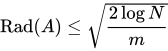
Bounds related to the VC dimensionEdit
Let be a set family whose VC dimension is  . It is known that the growth function of is bounded as:
- for all
 :
: 
This means that, for every set with at most elements,  . The set-family
  can be considered as a set of binary vectors over . Substituting this in Massart's lemma gives:
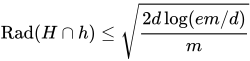
With more advanced techniques (Dudley's entropy bound and Haussler's upper bound[4]) one can show, for example, that there exists a constant  , such that any class of
  -indicator functions with Vapnik–Chervonenkis dimension has Rademacher complexity upper-bounded by
  .
.
Bounds related to linear classesEdit
The following bounds are related to linear operations on – a constant set of vectors in  .[2]:332–333
1. Define  the set of dot-products of the vectors in with vectors in the unit ball. Then:
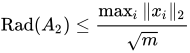
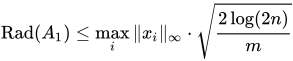
2. Define  the set of dot-products of the vectors in with vectors in the unit ball of the 1-norm. Then:
Bounds related to covering numbersEdit
The following bound relates the Rademacher complexity of a set to its external covering number – the number of balls of a given radius  whose union contains . The bound is attributed to Dudley.[2]:338
Suppose is a set of vectors whose length (norm) is at most  . Then, for every integer
  :
:

In particular, if lies in a d-dimensional subspace of , then:

Substituting this in the previous bound gives the following bound on the Rademacher complexity:

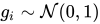
Gaussian complexityEditGaussian complexity is a similar complexity with similar physical meanings, and can be obtained from the Rademacher complexity using the random variables  instead of
  , where are Gaussian i.i.d. random variables with zero-mean and variance 1, i.e.
  . Gaussian and Rademacher complexities are known to be equivalent up to logarithmic factors.