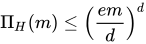
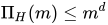
Uniform convergence in probability is a form of convergence in probability in statistical asymptotic theory and probability theory. It means that, under certain conditions, the empirical frequencies of all events in a certain event-family converge to their theoretical probabilities. Uniform convergence in probability has applications to statistics as well as machine learning as part of statistical learning theory.
The law of large numbers says that, for each single event, its empirical frequency in a sequence of independent trials converges (with high probability) to its theoretical probability. But in some applications, we are interested not in a single event but in a whole family of events. We would like to know whether the empirical frequency of every event in the family converges to its theoretical probability simultaneously.[citation needed] The Uniform Convergence Theorem gives a sufficient condition for this convergence to hold. Roughly, if the event-family is sufficiently simple (its VC dimension is sufficiently small) then uniform convergence holds.
DefinitionsEditFor a class of predicates  defined on a set
  and a set of samples
  , where
  , the empirical frequency of
  on
on  is
is

The theoretical probability of is defined as 
The Uniform Convergence Theorem states, roughly, that if is "simple" and we draw samples independently (with replacement) from according to any distribution  , then with high probability, the empirical frequency will be close to its expected value, which is the theoretical probability.[citation needed]
Here "simple" means that the Vapnik–Chervonenkis dimension of the class is small relative to the size of the sample. In other words, a sufficiently simple collection of functions behaves roughly the same on a small random sample as it does on the distribution as a whole.
The Uniform Convergence Theorem was first proved by Vapnik and Chervonenkis[1] using the concept of growth function.
Uniform convergence theoremEditThe statement of the uniform convergence theorem is as follows:[2]
If is a set of  -valued functions defined on a set and is a probability distribution on then for
  and
and  a positive integer, we have:

- where, for any
 ,
, 

- and
 .
.  indicates that the probability is taken over consisting of i.i.d. draws from the distribution .
 is defined as: For any -valued functions over and
  ,
,
And for any natural number , the shattering number  is defined as:

From the point of Learning Theory one can consider to be the Concept/Hypothesis class defined over the instance set . Before getting into the details of the proof of the theorem we will state Sauer's Lemma which we will need in our proof.
Sauer–Shelah lemmaEditProof of uniform convergence theoremEdit[1] and [2] are the sources of the proof below. Before we get into the details of the proof of the Uniform Convergence Theorem we will present a high level overview of the proof.
- Symmetrization: We transform the problem of analyzing
 into the problem of analyzing
  , where
  and
and  are i.i.d samples of size drawn according to the distribution . One can view as the original randomly drawn sample of length , while may be thought as the testing sample which is used to estimate
  .
. - Permutation: Since and are picked identically and independently, so swapping elements between them will not change the probability distribution on and . So, we will try to bound the probability of for some by considering the effect of a specific collection of permutations of the joint sample
 . Specifically, we consider permutations
  which swap
  and
and  in some subset of
  . The symbol
  means the concatenation of and .[citation needed]
 - Reduction to a finite class: We can now restrict the function class to a fixed joint sample and hence, if has finite VC Dimension, it reduces to the problem to one involving a finite function class.
We present the technical details of the proof.
SymmetrizationEdit
Lemma: Let  and
and

Then for  ,
,  .
.
Proof: By the triangle inequality,
if  and
and  then .
Therefore,
![{\displaystyle {\begin{aligned}&P^{2m}(R)\\[5pt]\geq {}&P^{2m}\{\exists h\in H,|Q_{P}(h)-{\widehat {Q}}_{r}(h)|\geq \varepsilon {\text{ and }}|Q_{P}(h)-{\widehat {Q}}_{s}(h)|\leq \varepsilon /2\}\\[5pt]={}&\int _{V}P^{m}\{s:\exists h\in H,|Q_{P}(h)-{\widehat {Q}}_{r}(h)|\geq \varepsilon {\text{ and }}|Q_{P}(h)-{\widehat {Q}}_{s}(h)|\leq \varepsilon /2\}\,dP^{m}(r)\\[5pt]={}&A\end{aligned}}}](https://wikimedia.org/api/rest_v1/media/math/render/svg/f8461f48d2fd7f0c2fe19203c871b9e67c8faf25)
since and are independent.
Now for  fix an such that . For this
  , we shall show that

Thus for any , 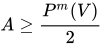 and hence
 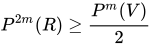 . And hence we perform the first step of our high level idea.
Notice,  is a binomial random variable with expectation
  and variance
  . By Chebyshev's inequality we get

for the mentioned bound on . Here we use the fact that  for .
for .
PermutationsEdit
Let  be the set of all permutations of
  that swaps
  and
and 
 in some subset of
  .
.
Lemma: Let  be any subset of
  and any probability distribution on . Then,
![{\displaystyle P^{2m}(R)=E[\Pr[\sigma (x)\in R]]\leq \max _{x\in X^{2m}}(\Pr[\sigma (x)\in R]),}](https://wikimedia.org/api/rest_v1/media/math/render/svg/9c1d969a0460869584bfda8851b74b1346b7bf94)
where the expectation is over chosen according to  , and the probability is over
  chosen uniformly from .
Proof: For any 

(since coordinate permutations preserve the product distribution .)
![{\displaystyle {\begin{aligned}\therefore P^{2m}(R)={}&\int _{X^{2m}}1_{R}(x)\,dP^{2m}(x)\\[5pt]={}&{\frac {1}{|\Gamma _{m}|}}\sum _{\sigma \in \Gamma _{m}}\int _{X^{2m}}1_{R}(\sigma (x))\,dP^{2m}(x)\\[5pt]={}&\int _{X^{2m}}{\frac {1}{|\Gamma _{m}|}}\sum _{\sigma \in \Gamma _{m}}1_{R}(\sigma (x))\,dP^{2m}(x)\\[5pt]&{\text{(because }}|\Gamma _{m}|{\text{ is finite)}}\\[5pt]={}&\int _{X^{2m}}\Pr[\sigma (x)\in R]\,dP^{2m}(x)\quad {\text{(the expectation)}}\\[5pt]\leq {}&\max _{x\in X^{2m}}(\Pr[\sigma (x)\in R]).\end{aligned}}}](https://wikimedia.org/api/rest_v1/media/math/render/svg/9f46a36c4d92d17e15ec97d1e17ba97a92ab9600)
The maximum is guaranteed to exist since there is only a finite set of values that probability under a random permutation can take.
Reduction to a finite classEdit
Lemma: Basing on the previous lemma,
![{\displaystyle \max _{x\in X^{2m}}(\Pr[\sigma (x)\in R])\leq 4\Pi _{H}(2m)e^{-\varepsilon ^{2}m/8}}](https://wikimedia.org/api/rest_v1/media/math/render/svg/c488981fe1f7d0ee58c749184eadf06c348bebd7) .
.
Proof: Let us define  and
and  which is at most
  . This means there are functions
  such that for any
  between
  and
and  with
with  for
for 
We see that  iff for some in satisfies,
  . Hence if we define
  if
if  and
and  otherwise.
For  and
and  , we have that iff for some
  in
in  satisfies
 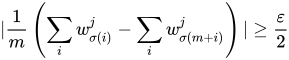 . By union bound we get
![{\displaystyle \Pr[\sigma (x)\in R]\leq t\cdot \max \left(\Pr[|{\frac {1}{m}}\left(\sum _{i}w_{\sigma _{i}}^{j}-\sum _{i}w_{\sigma _{m+i}}^{j}\right)|\geq {\frac {\varepsilon }{2}}]\right)}](https://wikimedia.org/api/rest_v1/media/math/render/svg/cc40ac1815ef47101a8440815d7aeccd74307766)
![{\displaystyle \leq \Pi _{H}(2m)\cdot \max \left(\Pr \left[\left|{\frac {1}{m}}\left(\sum _{i}w_{\sigma _{i}}^{j}-\sum _{i}w_{\sigma _{m+i}}^{j}\right)\right|\geq {\frac {\varepsilon }{2}}\right]\right).}](https://wikimedia.org/api/rest_v1/media/math/render/svg/076d1837b87ec317dca829e524a12af39a7ca5c4)
Since, the distribution over the permutations is uniform for each , so  equals
 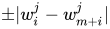 , with equal probability.
Thus,
![{\displaystyle \Pr \left[\left|{\frac {1}{m}}\left(\sum _{i}\left(w_{\sigma _{i}}^{j}-w_{\sigma _{m+i}}^{j}\right)\right)\right|\geq {\frac {\varepsilon }{2}}\right]=\Pr \left[\left|{\frac {1}{m}}\left(\sum _{i}|w_{i}^{j}-w_{m+i}^{j}|\beta _{i}\right)\right|\geq {\frac {\varepsilon }{2}}\right],}](https://wikimedia.org/api/rest_v1/media/math/render/svg/48244ac88425a73a9af7fe7ed2924fdc9a3600a9)
where the probability on the right is over  and both the possibilities are equally likely. By Hoeffding's inequality, this is at most
  .
.
Finally, combining all the three parts of the proof we get the Uniform Convergence Theorem.